How We Built Testability with Psychological Safety [External post]

Ben Linders recently interviewed me for my talk at AgileTD on how we failed at testability. That resulted in this InfoQ post about how to build in testability you need developers and testers to collaborate. But to be able to do that, you need psychological safety  

Testability can enable teams to make changes to their code bases without requiring extensive regression testing. To build testability, team members must collaborate and leverage each other’s unique skills. Unfortunately, effective collaboration does not come naturally to people and therefore needs leadership to nurture people’s ability to speak up and share their knowledge. 

To continue reading, head over to https://www.infoq.com/articles/testability-psychological-safety/

The courage to supercharge your testability

Testability is all about building quality-in. It’s about identifying known issues before they become a problem while coding. Pairing testers into this process can supercharge the testability feedback loop. It can allow you to pick up known and unknown issues.

But pairing devs and testers together needs courage. Courage so that both disciplines can take interpersonal risks and share hard things such as what they don’t know, don’t understand or mistakes they’ve made. This will need both groups to listen, understand and ask questions to help each other through the process. Both groups will need to show curiosity, humility and empathy for one another. You will not only feel uncomfortable during the process but it will take time too. The temptation to go back to inspecting for quality – dev and test handing work off to each other – will be hard to resist.

Pairing for testability is not just pair programming but working together to understand what the behaviour of the code being written should and shouldn’t do.

Devs and testers should work together to leverage the skills that each have, not get hung up about the skills they lack. If your pair is more exploratory focused identify ways that allow you to make the best use of those skills. If they are more technically inclined then focus there.

Remember the key is to build quality-in not inspect for quality. So what can you do now that helps your team move in that direction?

13 things I’ve learned from running remote workshops

Over the last 12-18 months I’ve been running a lot of remote workshops and during that time I’ve learned a few valuable lessons along the way. Most of my experience is based on translating and running an in-person workshop to a remote online workshop. The in-person workshop I’ve run 4-5 times and the online workshop I’ve run 8-10 times. The nature of the workshop is to help a team collaboratively create a model of how they work and then use that model to improve their ways of working. So it requires a lot of participation from every team member to be successful. What was my measure of a successful workshop? One that results in a visual model that everyone in the team agrees is how they work. 

With that in mind, this is what I have learned from running remote workshops that require group participation. 

1. Practice your setup if using screen sharing with slides and other apps 

Always check that what you plan to screen share works with your video call tool of choice. I’ve found that it never quite works the way you think so it’s always worth checking out beforehand. I’ve noticed that different apps can behave differently when screen sharing in full screen mode so a dry run of exactly what you plan to do can help iron out some of these issues. I’ve also noticed if you’re switching between apps e.g. Miro and Powerpoint then check that things switch back correctly as sometimes they don’t always switch the way you expect it to. I’ve also started to check with the audience that they can see what I want them to as there have been too many times I thought I was sharing and wasn’t.

2. You need to do more up front planning for remote workshops 

You have to plan for any workshop but with remote workshops, you need to plan for every eventuality.

With in-person workshops, you can experiment with ideas on the fly but this is trickier when people are remote. The main issue is communication. With in-person workshops, it’s really easy to tell everyone what you want them to do and then get almost instant feedback on whether or not they’ve understood it. But when people are remote you can’t see the feedback as easily so often you have to wait for the output and judge from that which can be harder if attendees are in breakout rooms.

3. Factor in extra time for tools

Online sessions typically require digital tools which if the group is unfamiliar with will have a learning curve which eats into your workshop time. But with in-person workshops you tend to use pens and paper which everyone understands how to use and if there are any difficulties in using the tools you can physically see what’s going on and intervene. Unfortunately I’ve found that with remote sessions it may not become apparent that something isn’t quite right until the results of the task can be seen. I’ve started to add 5 minutes of buffer to any group activity as it normally takes them that long to get going on most occasions.

4. Remote workshops can be more democratic and can give everyone a voice 

Remote workshops tend to level the playing field and physical presence becomes less of an issue. It can also be more democratic in giving everyone a voice if tool based signalling is used to indicate you want to say something. In some cases I’ve found using chat features can help some to share their thoughts or approach hard to discuss subjects too. But all these features can take longer so make sure you factor this into the session.  

5. Breakout out rooms of 3 are best

I found that limiting breakout rooms to 3 participants works best. The lines of communication are simpler, people contribute more and the overall result tends to be better. With groups of  4 or more, you start to see the dominant members taking over and the quieter ones sitting back. But in groups of 3, this doesn’t happen anywhere near as much.

6. Remote sessions need more breaks

I’ve seen participants during in-person workshops, while not ideal, quite easily contribute to 2-hour workshops, have a 10-minute break and go again. But for remote sessions, most people need a break almost every 50 minutes to be able to participate in half-day or whole-day workshops.

One of the main reasons being reported is fatigue. My guess is that in-person sessions do not cognitively overload the participants as you can use a lot more of your senses to understand what is going on and move about the room. But with remote sessions all you have is sound and a small field of view. So you have to listen more intently to what people are saying and generally stay seated/standing (if you have the option). Therefore giving people regular breaks gives their eyes and ears a rest.

One thing I would also suggest is encouraging the participants to step away from their screens during this time. I’ve found that some take the time to catch up on emails/notifications instead and then feedback that the workshop was too long.

7. Ice breakers are a really good idea 

I’ve found on occasions that people have come in from back-to-back meetings so it can take them some time to get into the workshop. Ice breakers can help participants to break out of whatever they were doing before and quickly and easily get into the new workshop/meeting.  It’s a bit like warming up before you get into your gym session.

They can also double up as a way to introduce people to a new tool via a simple game, get them thinking creatively or a way for people to connect before getting into the main session. I’ve found that while it does eat into the beginning of your workshop it can result in a better overall outcome for you and your participants. So where you can I highly recommend doing it.

8. Sessions never start on time 

It doesn’t seem to matter what time the meeting starts, I’ve played with 5 past, 10 past and even 15 minutes past. Some people still arrive 5 minutes after the allotted start time. It’s never many people but some people just have more meetings going on than others and it can be hard to get a comfort break in sometimes.  On the other hand you get some people who show up on time everytime. So it’s worth considering what will people do that show up on time and how will you get the stragglers up-to-speed?

Now you can ask the early arrivals to chat ideally or make themselves a drink but I’ve always felt like you’re punishing them for being on time. Which unintentionally sends the message that it’s ok to be late too. Ice breakers can be a good fit here as it gives the early arrivers something useful to do and if it’s a good ice breaker the late arrivers might just feel they missed out on something so they might try and be on time in the future.  It also means they are less likely to disrupt the main session trying to get up to speed.

9. Remote session can take longer 

Now, this may vary from workshop to workshop but from my experience, the modelling sessions I’ve been running have taken nearly 2-3 times as long. I think this comes down to a lot of different factors such as the participants’ familiarity with each other, tools being used, the outcome you’re trying to obtain and more breaks. So being able to test out a workshop is a good idea to figure out your timings and if it will need multiple sessions.

10. People are not paying as much attention as you might like

I tend to find that I end up repeating instructions during workshops quite a few times so keeping them simple and available in multiple formats can make this easier.

This goes for in-person workshops too but any instructions, objectives (if critical) and information (if complex or new to the participants) should be verbally and visually represented during workshops.  I’ve also found making it easy for participants to find for themselves can be handy too.

11. Don’t expect people to follow your instruction to the letter 

Just because you said use a felt tip pen they might use a biro.  Just because you said to use plain paper they might use lined.  Just because you offered to send them the resources don’t expect them to say yes to them.  Always think about how people could interpret your instructions. What might be significant to you may just seem incidental to them. In this way, in-person workshops are easier as you can give them everything they need and tweak instructions as you see things happening.  So if some requirement for your workshop is important and an equivalent  can not be used, make sure they know this upfront otherwise you might get some unexpected results.

12. You’d be surprised at what a pain it can be to take a photo and upload it 

For my workshops I thought that doing some drawings, taking a photo and uploading it to Miro would be quite easy but in general, it causes quite a few issues. Most people’s photos are taken at quite a high resolution and not everyone is familiar with how to lower it. So when they do upload them they can take a little time and being quite large means they almost always need to be resized – taking more time. Getting the images onto your PC can be tricky too as there are quite a few ways to do this and I was surprised how few people knew how to do it. While none of the issues are a major problem when you have enough people experiencing different issues at different times, the easy job of uploading a photo becomes a real time drain. I’m sure this will get easier with time and/or using dedicated apps but be sure to factor this in if you want people to upload images.

13. Always summarise what people have been doing and why 

I have always underestimated how often it’s worth repeating the aims of a workshop to the participants. Just because they have accepted the meeting invite and you have personally explained it to them it doesn’t mean they will remember why they are doing what they are doing.  One of the things that I’ve regularly gotten in feedback is people not being sure what the outcome of the workshop is.

I think this is because most workshops are completely new to attendees so they are taking on board a lot of new information. So they tend to miss the details and instead focus on the current task. What they tend to remember is the beginning, any significant events during and the end of the session. Also significant events might not be what you want them to remember as it could be someone making a joke or how a tool failed. So make the best of the start and end if you want them to take something away from your sessions.  

Which is best, remote or in-person? 

From my experience, I’ve found that both have their strengths and weaknesses. Remote sessions can allow people from anywhere to participate and usually involve digital tools which means the outputs are much easier to share and reuse. But the downside is you lose that person-to-person connection and the energy that comes from that. They can also take much longer and may need to be split up over multiple workshops depending on the type you are running.

In-person workshops on the other hand can be much more dynamic. By allowing you to change things on the fly, have a lot more energy which can be motivating and keep people engaged in the session for much longer. I also find they can become a bit of an event especially since we’ve all been working remotely which could work towards helping people engage in the process.  However, they can favour the more confident participants and making the outputs sharable and reusable can be tricker.

So which is best? Well, it depends on your context. If getting together is difficult then remote might be best for you but if the team is still new or you’re experimenting with an idea then an in-person session might be better.  I still prefer in-person workshops as I find that the social element of getting people together and working on something as a group still produces better ideas, faster and in my opinion builds stronger and longer-lasting bonds between people. Which all contribute toward a more cohesive team. 

Incremental improvements: Why don’t teams do it more?

(Reading time: 10 minutes) I’ve been working with a lot of different engineering teams over the years and there has been a strong tendency for them to avoid incremental improvements and instead go for bigger changes. There are many reasons they give as to why but three themes stand out: wrong incentives, lack of knowledge and risk aversion. What are the causes of these problems and is there anything we can do about it?

What are incremental improvements?

The incremental improvements are typically process based such as reducing queue times, limiting work in progress, using smaller batches of work, employing automation, using better testing techniques or removing the test column. Which all contribute towards aiding the team to ship value faster. But rather than go after the incremental improvements that they can get started on now they advocate for the new tool instead. 

The tools are usually dependent on the problems the teams are facing at that moment but typically can be a new CI system (usually moving away from Jenkins), the latest monitoring tool, new frameworks (e.g. automation tools) or even advocating for a whole new programming language.

Reasons teams often give for avoiding incremental improvements

The reasons for avoiding incremental improvements and advocating for the new tools vary but I’ve heard versions of the following over the years:

  • It feels easier to do big changes in one go rather then lot’s of smaller ones over time
  • It’s hard to see how the smaller individual wins over time improve the teams ability to deliver value
  • Nobody ever gets credit for fixing smaller things or preventing issues that then never occur
  • People get credit for making big bold moves that can be clearly seen
  • They tried the smaller ones before and it failed
  • They don’t see any problems with their ways of working so If it’s not broken, don’t fix it 

I tried listing out as many as I could and noticed a few themes starting to emerge specifically around incentives, understanding of agile development practices and risk.  

List of reasons people give for avoiding incremental improvements grouped into themes

Why does this happen? 

Which got me thinking, why this avoidance of incremental improvements? What is it in software teams that could cause so many of them to give such similar responses? Some of the teams have never met each other so it’s not like they’ve been swapping reasons. Which led me to look at what in the teams environments could cause people to behave this way. 

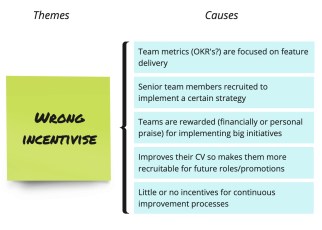
Wrong Incentives 

List of causes for wrong incentives

What incentives do we setup in teams and how do we do it? From my experience the recent trend has been all about Objective and Key results (OKRs). Now there is nothing wrong with having goals that teams should aim for, I actually think this is a good idea. But do those goals unintentionally encourage feature delivery over improving the system? In some ways we maybe rewarding teams to go after bigger ideas rather then working to incrementally improve their system. To see what I mean have a look at your teams goals, do any of them encourage the team to improve their ways of working or are the focused on some business objective?  

These goals may also encourage leaders to recruit people that are there to simply achieve that goal and incentives them to do so either via praise or other rewards. This has another affect in that the job adverts they put out ask for people with skills that can achieve that goal. Which could lead people to make sure they have those skills on their CV so that they can apply for those roles. Again further reinforcing team members to go after the bigger wins  – no one is explicitly asking for them to go after the smaller wins that improve their system. It’s just assumed that they would do this.

Just to reiterate I’m not saying we shouldn’t use OKR or other goal setting techniques but we should stop and look to see what behaviours they collectively do and don’t encourage. 

Lack of knowledge 

List of causes for lack of knowledge

In some teams (especially smaller organisation) they offer very little time if any to actually train on the job. So people are more likely to prioritise personal development that is actually going to get them more of what they want which is usually pay. Which after reading a few job adverts (see incentives above) they are likely to be tangible skills and not how to successfully improve the team’s processes. 

In organisations that do have training opportunities and especially ones around agile ways of working than the team member has another issue: how does the training relate to them and their teams? These training options while on paper are a great thing they tend to be quite generic and leaves the actual implementation to the novice who needs all the help they can get. Therefore unless their team actively encourages them to share what they learned (e.g. by setting up experiments to try things out) the individual has little chance of changing the teams ways of working. 

The another issue is how does experimenting with their ways of working fit in with the organisational goals? This goes back to incentives again in that even though you have this new insight from the training trying this out doesn’t seem like the right thing to be doing. Especially if it looks disruptive and the outcome uncertain and the current ways of working seem to be doing a good enough job. If it wasn’t then they’d surely have it as a team objective? 

The other big issue I’ve seen in teams is no consistent understanding in how their team actually works. The process by which a lot of team adopted tend to happen out of chance or things that were implemented long before most of the team was even around. That coupled with varying levels of experience in the team means no one person fully understands how the teams works.

Risk aversion 

List of causes for risk aversion

The final issue and the one I think people are most familiar with is avoiding risk. You’ve probably heard the reasons such as we’ve tried that before and it didn’t work, or nothing is broken so why try and fix it. In some cases they do nothing as there are so many choices they don’t know which to go for so they stick with what they’re already doing as that kind of works and has a more certain outcome. 

This I feel comes from people not wanting to take risks or if they do then they have a high probability of success – so it’s not really a risk. Think about when was the last time you were rewarded for failing? This hardly ever happens but I bet you can think of a time you or another team was praised for doing something successfully. By only ever rewarding success (an email with some praise can be enough) then you unintentionally punish failure. Not only that failing never feels good and knocks our self-esteem so we tend to do all we can to avoid it. If failure does occur we will deny it was us, distort it so it looks better then it was or just ignore it and carry on as if nothing ever happened. 

Add to this that even speaking up about failure is hard as no one wants to be judged about being incompetent, looking ignorant, causing disruption or generally being considered negative then no wonder we tend to avoid failure. This all leads us towards going after a sure thing like a big process change that will give us everything we want in one go. 

What do we do? 

Trying to solving any of these issues is going to be a difficult thing to do and likely to lead to lots of false starts, dead ends and failures too. For most teams and organisations these issues are just too complex and are likely to be ignored all together or left for someone else which typically means no one. So is there anything we can do? 

3 Questions 

I think a good start would be if we asked ourselves at the team level how are we framing incentives, training and risk taking? This line of thought led me to 3 questions that could help Team Leads start to tackle some of the reasons why teams go for big changes rather then smaller incremental improvements. 

Question 1  – Have we unintentionally incentivised big wins over smaller incremental improvements?

Have we unintentionally incentivised big wins over smaller incremental improvements?

Take a look at your teams goals and objectives. Do any of these encourage your teams to make smaller incremental improvements or big wins? Could you reframe the conversation around any of these goals that could encourage more smaller incremental improvements? How can you maintain that framing as the team work towards accomplishing that goal? Are there any examples you can highlight to the team that show others working in this way in a similar context? 

Question 2 – Could centralised training unintentionally remove responsibility from the teams needs to the individuals needs?

Could centralised training unintentionally remove responsibility from the teams needs to the individuals needs?

How do you identify the training needs of your team? Is it on an individual-by-individual bases or a more whole team view? How does the training your team members go on relate back to how the team works? How often do you do whole team training? When an individual does do some training how are they encouraged to use what they learned back in the team?   

How does your team communicate their ways of working to others? Do they have a consistent structured approach or is it more ad-hoc and depends on who you ask? When do you take the time to understand how the team is currently working and if things need to change? Do you have any metrics on team performance that tell the team if they are getting better or worse at what they do? 

Question 3 – By only ever rewarding successes have we unintentionally punished failure?

By only ever rewarding successes have we unintentionally punished failure?

How do you recognise successes and failure in your teams? Do they get equal amounts of attention or is it just the successes that are talked about? When was the last time you failed and you shared that with the team? What was the focus of the discussion? Was it positively or negatively framed? Do you have a structure to understand and learn from failure or is it up to the individual to figure it out for themselves? Learning from failure is not easy and needs strong leadership to enable it so what can you do to encourage and enable it to happen more frequently and positively? 

It’s always about the discussion

None of these questions actually solve the problem of teams focusing on bigger wins over smaller incremental improvements and perhaps in some cases the bigger win is the right solution. For example cases such as do or die situations where the team isn’t going to exist if it doesn’t make huge changes overnight. But I would hope this isn’t a regular occurrence for teams otherwise you’ve probably got bigger problems than training or misaligned incentives.

What these questions do is get the discussion started by getting people into the right frame of mind to have that conversation and start working towards a solution. The solutions to these problems are likely to be very context dependent so what may work for one team might be the wrong for another. Therefore me or anyone else proscribing a particular solution may not be that helpful. You need to be agile in your context. Starting with the right questions might just get you to the solutions you need.

What do you think? 

Have I got it wrong and are big wins the best way most of the time? 
Am I missing any common reasons teams give? 
Have I made assumptions in my causes to fit the narrative I’ve set out? 
Is my analysis just plain wrong? 
Let me know in the comments 

The risk with direct questions

The risk with the direct question is that the person being asked could assume intent within the question. E.g. asking what risk there in this release could be assumed that you think there is a risk in the release or that you don’t trust the individuals ability. 

This could lead to a break down in your relationships and make asking any further question almost impossible. This is more likely if you don’t have a working relationship with the person and is another good reason why taking time to get to know each other is so important. See foundations of great teams start with relationships to learn more.        
So what do you do if you need to ask questions that could be interpreted as having intent?  

Use indirect questions 

The indirect question come across much more tentatively and allows the person being asked to offer more if they want to. If it is taken in the wrong way it also allows you to back out and try and get back to a productive conversation. 

Now if they respond in the negative with no additional information as to why then you can tentatively inquire as to what makes the individual so sure. e.g. That’s great, what is it about this release that makes you so certain? 

Examples 

  • Direct: What risks are there in this release? 
  • Indirect: Do you think there could be any stakeholder impact in this release? 
  • Direct: What could go wrong with this release? 
  • Indirect: Are there any ways in which you think this release could behave unintentionally? 
  • Direct: What risk mitigation have been carried out for this release? 
  • Indirect: Are there any areas you think we could have impacted with this release? 

The indirect questions asks the person for their opinion on the situation which takes away any emphasis on their work. While the direct questions don’t mention anything about their part in the work the risk that they could interpret your body language/tone or some past interaction as the reason behind you asking could derail the conversation. Essentially they may not give you the benefit of the doubt and jump straight to malicious intent even though there is none. 


Trade-offs of indirect questions  

The downsides of indirect questions is that they take longer to ask and more effort to construct. Which slows down feedback loops and learning from each other. It also makes long term collaboration that much harder and more likely for people to avoid situations all together. 

While building effective working relationships seems like a lot of effort I believe the long terms benefits of more effective collaboration is well worth it. Good relationships lets you just talk to each other.  

Reducing Uncertainty in Software Delivery

I recently attended a half day online event that InfoQ held on Reducing Uncertainty in Software Delivery. The thing that made this half day event different was the underlying focus on testing but without a single tester present in the talks or panel discussions. The majority of speakers where developers and there was even a few Engineering managers, Product people and a CEO or two. It also appeared to me that none of them have come from a traditional testing background. However they all made points that a good tester would and then some. The advantage they appear to have over testers is that they were able to incorporate their knowledge of their discipline to give a much broader view than just focusing on the testing itself. 

A key theme that I’m seeing from these talks is that they are spending a lot of effort on learning from failure. Either by analysing ones that have happened in production or actively encouraging teams to cause failures. It was only the more advanced organisations that were taking this approach but the others were not far behind. Why? To make their systems even more resilient. Their approach appears to be using Site Reliability Engineers (SRE) to work along side their engineering teams to help them do the work but also enable the teams to extract the learnings from it too. This isn’t simply having chaos testing to cause failures or postmortems for production failure analysis but to also help teams with the people side of working with and handling failure productively.

The talks that caught my interests were Building in reliability (SRE at Gremlin), User Simulation for Rapid Outage Mitigation (SRE at Uber), and a panel discussion on Testing in production (with 2 CEOs, Product person and an Engineering Manager). 

Now this is a small sample, the speakers are very experienced and working or have worked at some of the best known web based organisations (Google, Uber etc) and US focused too. But I’m seeing a lot of things that testers could advocate for being pursued and implemented by Site Reliability Engineers (SRE). For example: 

  • testing in production,
  • building in observability,
  • pushing testing earlier in the process,
  • encouraging developers to test their own work 

The advantage SREs have is they already have the technical ability and are now starting to build out the socio-technological skills that they were lacking previously. These organisations have another advantage in that they are heavily focused on learning from their failures. So when they do get things wrong they work hard to make sure they extract as much value from that failure as possible. On top of that some of these organisations are actively causing failures within their systems to further limit catastrophic failures that could occur.  Some of these organisations have never had tester and from the looks of things never will. If you’re pursuing a true continuous improvement strategy testers could look like a bottleneck in the process slowing down information flow. How can testers enable the flow of information and what can they add that makes this information even more valuable?  

I’ve pulled my summaries of the talks I found interesting below 

Talk: User Simulation for Rapid Outage Mitigation

Uber uses an alternative approach to end-to-end testing due to their system being so big that no one person can ever fully understand it. Instead they use composable tests that each team will create that allows that team to tests their part of the system but mix in other parts pre and post steps built by their dependent teams. These are then run in a simulation environment that allows them to see how the system will perform when that change is deployed. To incentives team to build the tests they use a mixture of pain (woke-up at 3AM due to production failure) and mitigation support team (hold their hands at 3AM) to encourage them to build the tests. For example if you had these test you wouldn’t be awake at 3AM trying to mitigate the issue. They also don’t try and solve the issues at 3AM but mitigate them so others can also learn about outages that affect their system.

Talk: Building in reliability

Interesting talk focusing in on availability of systems within organisations. The speaker walked through how you could go from 99% availability to 99.99% and how it is a learning journey. Used a simple analogy going from crawling, walking and running to get your availability towards what makes sense for your organisation. Essentially can you do it manually, can you script it and can you automate it? I find this slide as a great way to help others understand what the outcomes are at each stage going from 99% to 99.99%.

Panel: Measuring Value Realisation Through Testing in Production

I usually only see these types of conversation from tester focused panels but none of this panel where testers. Tester focused panels typically focus on testers testing in production but this was very much focused on learning from real users in production. Interesting thing from my prospective was they made all the points that I would expect a reasonably experienced tester to bring. In some cases due to their roles being out of testing they focused on the costs and benefits that were outside of simply testing in production e.g. down side of A/B testing or product management mindset shifts that need to happen to embrace learning from users rather then whatever the road map they have decided says.

In some ways testers testing in production almost act like the middlemen of the learning that happens during testing. Could it be that in some cases testers are getting in the way for teams to learn effectively from testing in production?

Scales of Collaboration

Reading time: 3 minutes 

Idea in brief: The scales of collaboration can help you and your teams to work more effectively by improve your collaboration. It allows you to measure how you are currently collaborating and what you can do to improve its effectiveness. But what’s wrong with our current approach and how do you use the scale?

Issues with existing collaboration

Whenever I talk with people who work in teams one of the things I hear quite often is how much they are collaborating. But when we start digging into what they are doing you begin to notice that everyone has a different idea of what collaboration means.

This results in behaviours between team members that puzzles them when they think they’ve done everything right but the other people don’t respond in the way they anticipated. 

Examples I’ve heard of collaboration :  

  1. ‘They should know where to find all the information’
  2. ‘I sent them an email with all the details, they just never did anything with it’
  3. ‘I gave them an opportunity to feedback anything they wanted, they didn’t so it must be fine’

In all three cases the people involved believed they where attempting to collaborate but in reality all they where doing was making information available. It was up to the recipient to decide what to do with the information if anything. 

Scales of collaboration

If this isn’t collaborating then what is it and for that matter what is collaborating? This is where the scales of collaboration could come in useful. Taken from the work of Bruce B. Frey et al 2004,  Measuring Change in Collaboration Among School Safety Partners . Which was originally developed from Levels of Community Linkage Model (Hogue, 1993)*. It was developed as a questionnaire to measure how well groups of people collaborated. 

*Which unfortunately I’ve been unable to find the original paper only references to it

This works on 0 to 5 scale with each level having a defined set of characteristics. Where 0 is no interaction at all and 5 being collaboration. With each level building on top of the previous one.  

Scales of collaboration
Scales of collaboration developed from Levels of Community Linkage Model (Hogue, 1993)

When applied to the collaboration examples above you can see that example 1 is just making the information available which would indicate level 1 – Networking. Example 2 while is providing the information isn’t asking them to do anything which is level 2 Cooperation. Example 3 would welcome feedback but isn’t explicitly asking or providing them with a mechanism to do so therefore it would also be level 2 Cooperation.

Following the scale up towards level 5 begins to highlight what else each example would need to do to improve their collaboration.

Characteristics of collaboration

I have further augmented the scale with a few extra characteristics. This will also help you work out where you are on that scale and what you trying to achieve. This includes 

  • How you make information available to others 
  • Consumer/provider interaction model of this information 
  • Speed of decision making
  • Engagement levels of the people involved 
  • Examples of what each level of collaboration could look like 

I’ve also left off level 0 on this diagram as that would indicate no interactions and possibly not even awareness of one another.  

How to us it?

  1. Establish where you are on the scale  
    • You could do this by seeing if what you are doing fits onto the scale based on its characteristics or if it looks similar to the examples on the scale provided 
    • Once you’ve established where you are on the scale then
  2. Where do you want to be on the scale? 
    • The best way to do this is to identify the aim you are trying to achieve based on: 
      • The information: 
        • Is it just information providing, an opportunity to get feedback or to change opinions/direction?  
      • Decision Speed:
        • How quickly does a decision needs to be made
      • Engagement: 
        • If something needs to change due to that information and/or decision then there will be a greater need for engagement 
  3. How will you move up (or down) the scale? 
    • Use the characteristics on the scale as possible things you could do to move to this level
    • What do you need to do to move in the direction you want to go in?
  4. Share the scale with the people you are trying to collaborate with
    • This would create a shared understanding of what collaboration means to this group
    • Which helps everyone involved understand what is going to be expected of them and what overall outcomes everyone is trying to achieve

If you have already started to work with people then I would also avoid trying to jump straight to where you want to be. The risk being that it doesn’t lead to the collaboration you anticipated. Which could make it much harder to convince those people of your collaborative efforts in the future. 

My personal preference is to use each stage of the scale as a stepping stone to the next. This way you iteratively build up your skills and approaches towards getting more of what you want and less of what you don’t. This also allows more room to tweak approaches as you get feedback and are therefore more likely to be successfully in the long run.

What do you think?

  • What do you think of the scales of collaboration?
  • Where do your teams sit on the scale?
  • Would this help you and your teams to collaborate more or less?

Let me know in the comments section below.

Why is psychological safety important to software engineering teams?

4 minute read

Update: Scroll to the bottom for a video of what is Psychological safety and why should you care in under 10 minutes.

Before you can answer this question you need to know what psychological safety is. Amy Edmondson in her book The Fearless Organisation describes it as: 


The belief that the work environment is safe for interpersonal risk taking

The Fearless Organisation

The best way to understand what this means is to break down the three key areas.


Interpersonal risk

Interpersonal is defined as relating to relationships or communication between people therefore interpersonal risks are issues that could affect relationships or communication. This can be thought of as others perceiving you to be: 

  • ignorant – when you share you don’t know something
  • incompetent – when you make a mistake as you don’t know how to do something
  • negative – when you highlight mistakes, issues or potential problems
  • disruptive – when you make suggestions that are different to others or generally asking questions that no one else is

The most effective way to counteract these risks? Staying silent or limiting what you do say to just the bare minimum.

The problem here is that those very risks are some of the best ways we can learn from each other. By not taking those risks we slow or even limit the innovation opportunities for ourselves and others.

Work environment 

This can vary from situation to situation but typically the group of people you find yourself working with to accomplish some goal.  For software teams this is usually the team in which you work in day to day. But other working groups could also exist such as your peers across the department or the leadership team you are a part of. 

Belief 

This relates to the individual within a work environment and is what they think about taking interpersonal risks.

What does a psychologically safe environment look like? 

Based on the above definition a work environment would be one that allows individuals to speak up and take interpersonal risks by asking questions, saying they don’t know something, pointing out problems, admitting to making mistakes or make alternative suggestions without other people thinking less of them for it. In fact it is actively encouraged and rewarded to speak up in this way. 

A point to note is that psychologically safe environments don’t mean that there can never be any conflict. In fact it’s quite the opposite and that conflict is almost a characteristic of psychologically safe environments. In an environment like this individuals can have different views but, importantly, can work through them productively without resorting to stalemate.  

Complexity in the work environment 

A lot of work done by software engineering teams can be thought of as complex. Complexity arises from a number of factors such as uncertainty in what needs to be done, how best to do it and if the outcome is even obtainable. On top of that no one person can understands all the intricacies involved with the work due to most systems being larger than any one person can fully understand. This leads to high levels of interdependence between team members while they carry out the work and learn more about the system as they go.  This all needs highly effective collaboration between teams members to work out what needs to be done, how they will do it and how they will know it’s been successful.

These are some of the core reasons why software teams adopt agile delivery methods as they take into account this complexity and allow the people involved to learn as they deliver the system. 

Effective collaboration for group learning 

Effective collaboration between team members isn’t simply each person completing their part of the work and then handing this off to the next person like a production line. All this requires is effective cooperation between team members and coordination to fit all the pieces together*. The problems with this production line framing of the work is that it misses the interdependence that exists between team members due to the complexity in the work environment. 

With effective collaboration individuals are able to learn from each other much more effectively as they are able to speak up and take the interpersonal risks without needing to second guess if their fellow team mates will think less of them for it.

*learn more about cooperation, coordination and effective collaboration using the scales of collaboration

Why is psychological safety important to software engineering teams? 

Creating software systems needs people to share information due to the complexity involved with the work. One of the best ways to make sure that information can flow freely as possible is for the people involved to feel it is safe for them to take interpersonal risks. While this does not guarantee success, teams that do are more likely to identify issues, come up with solutions and implement them much quicker than teams that don’t.

Psychological safety is a characteristic of highly performing teams and is a prerequisite for effective collaboration which is fundamental within software teams. 

Video: What is Psychological safety and why should you care?

What do you think?

Do teams need psychological safety?

What else can they do to help smooth the flow of information in teams?

How have your teams addressed collaboration?

Three things of 2020

3 minute read

Below are three things that when I reflect back on 2020 that stand out to me. I’ve purposely not mentioned COVID because I think this is one thing that all of us would have on our list so didn’t think there was anything more I can say on this that no one else is already thinking. I’ve also included my three things from 2019 at the end which I still think are important. 

🌳 You can’t stick your apples on other people’s trees

  • Something that Sarah has been trying to tell me for some time but it never really clicked until this year 💡
  • I’ve learned a lot this year about how we learn and what we can do to enable more or it
    • My apples…
  • But there is one thing that keeps coming back
  • It doesn’t matter how many different ways you find to engage people with the content
    • Unless they really care about it they may never have the insights that you think they should have 
    • They may never see the benefits you do or incorporate that that information into their ways of working 
    • This is all about trying to stick your apples on other people’s trees…
  • Usually they are just too busy to even be able to give it the time 
  • The best approach is for them to find ways to incorporate into their own learning 
    • To encourage them grow their own apples…  
  • This takes a lot more time than simply forwarding a link to read or even sending them on workshops/training courses… 

Speaking of apples…

🍎 Informal Relationships

Informal Relationships between team members is the key foundation for high performing engineering teams

  • Most teams members can work with each other quite efficiently but the level with which we do makes the difference between low and high performing teams 
  • We can cooperate and coordinate quite well as can be seen by how well teams can slice up work into tickets and hand them off to the next stage (cooperating). Some teams take this further and begin coordinating their actions using information from their step in the process to inform the next stages (coordinating)
  • But coordinating with teams members isn’t enough we need to be able to collaborate because of the level of complexity we work in means no one person can ever know it all. This essential and often forgotten detail makes team members interdependent 
  • It’s the level of how well we can collaborate and work through problems that gets teams towards higher levels of performance. This performance can be measured by how sustainably the team can deliver end user value (throughput)
  • Psychological safety plays a big part in this interdependence and collaboration and can be characterised by how well people in the team can “just talk to each other” 
    • Psychological safety being the belief of individual team members that it is safe within their work environment to take interpersonal risk 

🎓 Learn more: Fundations of great teams? Start with relationships

🍏 Manager or Leader? 

Understanding the difference between the two can be really helpful  

  • One of the things that has really stood out for me this year has been the difference between management and leadership
  • I always conflated the two and never really appreciated the difference
  • Since then I’ve not looked at software engineering teams the same again
  • Do other make the same mistake? 
    • Leading to confusion on when we should be leading our teams and when we should shift to a more management style 
  • A Hybrid model may also be workable 
    • especially the closer you get to where the work is happening 
    • With a heavy slant towards leadership then management 
    • But the further you get from it the more a leadership style works best 
  • A simple heuristic: 
    • the less experienced a member of staff then a more hybrid approach 
    • but the more experienced they are then a more leadership style is appropriate  

Three things 2019

Teams

  • Working as a team will accomplish more than just working alone 
  • I’ve tried and accomplished some things with some good results 
  • But nothing compared to what I’ve contributed to as a team
  • But it starts with trust… 

Trust 

  • that people really do know what the best course of action is
  • They just sometimes need help thinking things through 
  • Which needs people to listen…  

Listen

  • And I mean really listening
  • This has by far been the most important thing I’ve done this year
  • Just asking very open questions and listening to what people say 
  • I’ve learned more about people and what is happening in our teams from this than any other way 
  • The interesting thing is the people I’ve listened to seem to get so much more out of it 
    • I think this is because not many of our team members get a chance to be listened to… 

What are your three things for 2020?

Let me know in the comments below

Foundations of great teams? Start with relationships

4 mins reading time

tl;dr: check out my miro model to get the key points.

Model of who do we prefer working with 

https://miro.com/app/board/o9J_khGWgWc=/
Good informal relationships are they key to better collaboration https://miro.com/app/board/o9J_khGWgWc=/

Over the last couple of years I’ve started to see that relationships between people appears to play a big role in how successful their teams are. The better the relationship the more willing those people are to share ideas and learn from each other. Which generally leads to much better results for those teams in the long run. Not only that they get those results a lot faster and are typically happier too.

But this is work so shouldn’t we be leaving our personal feelings at the door when it comes to getting things done? What do relationships have to do with anything?

Who do we prefer to work with?

One thing I have seen is that when people like each other they tend to be more likely to work together then people who don’t like each other. Generally for people who don’t get along their interactions tend to be the bare minimum usually resorting to asynchronous methods of communications like email or other group message systems (Slack, Teams etc). They pretty much do anything they can to avoid face-to-face contact.

The problem here is that this can leave messages more open to interpretation and further exacerbate poor relationships. Not only that sharing information this way can at times be slower than simply speaking face-to-face.

But how much do people have to like each other to work together successfully and is there anything we can do to make sure people who do have to work together can get along? 

How much do people have to like each other?

The amount tends to be quite subjective but these types of relationships are usually characterised as work colleagues or sometimes work friends.  They are essentially informal relationships between people who work together where they are very likely to say that the like each other. Multiple informal relationships lead to informal networks which can make working in teams much more productive and enjoyable for the people involved. 

The benefit of informal networks is that they are more likely to lead to collaborative behaviour that enables learning from each other. This in turn can lead to new ideas and innovations. Which all successful teams need.

What can we do to help people get along more? 

By helping people to find more common ground with each other tends to lead people to think of each other as we rather then us and them. This common ground can help people to see that they are similar to each other which can lead to familiarity. Both of which can help towards more positive reciprocal behaviours towards each other. All three of these (similarity, familiarity and positive reciprocal behaviours) benefit us psychologically by making us feel good.

Feeling good to think and collaborate

When we feel good we are more likely to think freely rather than when we feel threatened and are looking to protect ourselves. When we are threatened our brains actively limits resources from working memory. Working memory is a key component for analytical thinking which you need for creative insight and problem solving.  

The level of collaboration is also improved as when we feel good we are also more accepting of people’s differences and more willing to take interpersonal risks with other people.  Interpersonal risks are very personal to the individual but can typically be classified as:

  • Looking incompetent because you don’t know something when you think you should 
  • Thinking you are being disruptive by wasting someones time by asking questions or needing things to be explained in more detail
  • Looking ignorant because you don’t know something  

All three of which can have perceived negative consequences to your reputation.

All these risks need people to be vulnerable in front of others so that they can learn from each other and therefore collaborate more effectively. But if they are unwilling to do this then they are not going to share what they do and don’t know which leads to less effective teams. Essentailly everyone has to figure things out forthemsevles instead of learning it quickly from someone else.

Feeling good means better innovations?

Better team member relationships, feeling good, collaboration and learning from each other doesn’t guarantee that the team will come up with best and most efficient solution to a problem. What it does do is create the right conditions for those solutions to found and implemented.  

Not only that a team that enjoys working together and is able to work through their differences is more likely to keep doing this repeatedly and get better at it every time they do. Therefore leading to more ideas and increased likelihood of the team finding alternative solutions to problems. One of which might just be that innovation your organisation has been looking for to give them the edge over their rivals.

What are the trade-offs to all this harmony?

There is a risks of overly harmonious teams though. This is that they are less likely to challenge each other and are more likely to go with the flow. Which could actually lead to less innovation and creativity. As they are more willing to just accept the first idea rather than challenging it which could risk the team harmony. So some level of “creative abrasion” is needed to help people productively challenge ideas.

But again good working relationships will help stop challenging situations from causing so much tension that people begin to refuse to work with each other.

Is there data that back this up?

Research by Tiziana Casciaro and Miguel Sousa Lobo for their 2005 paper Competent Jerks, Lovable Fools, and the Formation of Social Networks backs up a lot of the ideas above. Their data was based on surveying 4 large organisation and collecting over 10,000 data points on work relationships.

You can find my notes in this model.